

- By admin
- August 21, 2026
- Comment Off
Choosing the right Web Hosting is one of the most important decisions when building a website. Your hosting affects your website’s speed, reliability, security, scalability, and overall user experience. With so many Hosting Solutions available, understanding shared vs VPS vs cloud hosting can help you choose the right option for your needs.
The three most common choices are Shared Hosting, VPS Hosting, and Cloud Hosting. Each has different advantages, limitations, and pricing.
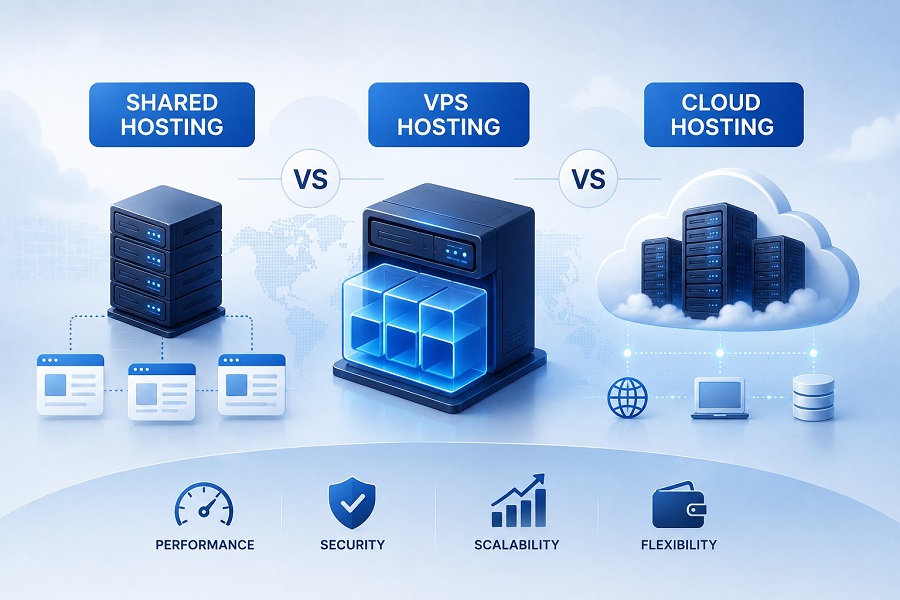
So, shared vs VPS vs cloud hosting which is better? There is no single answer. The best option depends on your website size, Website Traffic, budget, technical requirements, and expected growth.
In this guide, we’ll compare these hosting types and explain shared vs VPS vs cloud hosting which is right for your website.
What is Shared Web Hosting?
What is shared web hosting? Shared hosting is a type of Website Hosting where multiple websites use the resources of the same physical Hosting Server.
Think of it like renting an apartment in a large building. You have your own space, but you share the building’s infrastructure with other residents.
With Shared Hosting, multiple websites share resources such as CPU, RAM, storage, and bandwidth. This makes it one of the most affordable hosting options available.
Advantages of Shared Hosting
Shared hosting is popular because it is:
- Affordable
- Easy to set up
- Beginner-friendly
- Usually managed by the hosting company
- Suitable for small websites
- Easy to maintain
For a new blog, portfolio, local business website, or small Business Hosting project, shared hosting can be a practical starting point.
However, because resources are shared, a sudden increase in traffic on another website can sometimes affect available resources and Website Performance.
What is VPS Hosting?
What is VPS hosting? VPS stands for Virtual Private Server. A VPS uses virtualization technology to divide a physical server into separate virtual environments.
Although several VPS accounts may exist on the same physical machine, each account receives allocated Server Resources and operates more independently than a traditional shared hosting account.
With VPS Hosting, you generally get more control, performance, and flexibility than with shared hosting.
Advantages of VPS Hosting
VPS hosting can provide:
- More dedicated resources
- Better performance
- Greater control
- Improved scalability
- More customization
- Better isolation from other websites
- Root or administrative access with many plans
A VPS can be suitable for growing websites, applications, ecommerce stores, and businesses that have outgrown shared hosting.
The trade-off is that VPS hosting can require more technical knowledge, particularly with unmanaged plans.
Need business hosting? Get in Touch!
What is Cloud Hosting?
What is cloud hosting? Cloud hosting runs websites and applications across a network of interconnected servers rather than relying on a single physical server.
This distributed infrastructure can provide flexibility and scalability. If your website experiences sudden increases in Website Traffic, cloud infrastructure can often allocate additional resources more easily than traditional hosting environments.
Cloud hosting is commonly used by growing businesses, ecommerce websites, applications, and websites with changing resource requirements.
Advantages of Cloud Hosting
Cloud hosting can offer:
- High scalability
- Flexible resource allocation
- Strong reliability
- Excellent performance
- Greater infrastructure flexibility
- Better handling of traffic spikes
Because cloud infrastructure is distributed, it can also provide redundancy that helps reduce reliance on a single physical server.
Website Hosting vs WordPress Hosting: What’s the Difference?
VPS vs Cloud Hosting
The VPS vs cloud hosting decision depends largely on your requirements.
A VPS provides a virtualized server environment with allocated resources. Cloud hosting uses a network of servers and is generally designed for greater flexibility and scalability.
A VPS can be a good option when you want more control over your server environment without moving to a large cloud infrastructure.
Cloud hosting may be more suitable when your website experiences unpredictable traffic or needs to scale quickly.
Cloud Hosting vs Shared Hosting
When comparing cloud hosting vs shared hosting, the main differences are performance, scalability, resources, and cost.
Shared hosting is designed for affordability and simplicity. Cloud hosting is generally designed for websites that require greater flexibility and infrastructure capacity.
A small website with modest traffic may not need cloud hosting. However, an ecommerce store experiencing regular traffic spikes may benefit from a more scalable hosting environment.
Need WordPress Hosting for Business? Get in Touch!
Difference Between Shared VPS and Cloud Hosting
The difference between shared VPS and cloud hosting comes down to how resources are allocated and how the infrastructure is structured.
- Shared Hosting: Multiple websites share resources on one server.
- VPS Hosting: A physical server is divided into isolated virtual environments with allocated resources.
- Cloud Hosting: Website resources are delivered through a network of interconnected servers.
Each option serves a different purpose, so choosing the right one depends on your website’s requirements.
Web Hosting: 7 Warning Signs Your Website Needs Better Hosting
Which Hosting is Best for a Website?
So, which hosting is best for a website?
There isn’t a universal answer.
Shared Hosting
Best for:
- Personal blogs
- Small business websites
- Portfolios
- Basic informational websites
- New websites
VPS Hosting
Best for:
- Growing businesses
- Medium-sized websites
- Applications
- Websites requiring more control
- Websites that have outgrown shared hosting
Cloud Hosting
Best for:
- High-traffic websites
- Ecommerce platforms
- Growing businesses
- Applications
- Websites with unpredictable traffic
- Websites requiring strong scalability
What Type of Web Hosting Do I Need?
If you’re wondering what type of web hosting you need, start by evaluating your website.
Consider your current Website Traffic, expected growth, required Hosting Storage, Bandwidth, security requirements, technical skills, and budget.
A small website doesn’t necessarily need expensive cloud infrastructure. Similarly, a busy ecommerce website may struggle with the limitations of basic shared hosting.
Choosing hosting based on actual requirements can help you avoid both underpowered and unnecessarily expensive plans.
Final Thoughts
The choice between shared vs VPS vs cloud hosting should be based on your website’s current needs and future plans.
Shared hosting is affordable and beginner-friendly, making it suitable for smaller websites. VPS hosting provides more control and dedicated resources for growing websites. Cloud hosting offers flexibility and scalability for businesses and websites with demanding or unpredictable resource requirements.
If you’re starting a new website, shared hosting may be the most practical option. As your Website Traffic and resource requirements increase, moving to VPS or cloud hosting can provide the additional performance and scalability you need.
Ultimately, the right Hosting Service isn’t necessarily the most expensive one. It’s the one that provides the right balance of Website Performance, Hosting Security, Server Resources, Bandwidth, Server Uptime, Hosting Storage, scalability, support, and Hosting Cost for your website.