

- By admin
- August 29, 2026
- Comment Off
Choosing the right domain name is one of the most important decisions when building a website and establishing an online brand. Your domain name is more than just your website address. It represents your business, helps customers find you online, supports brand recognition, and can influence how professional and trustworthy your business appears.
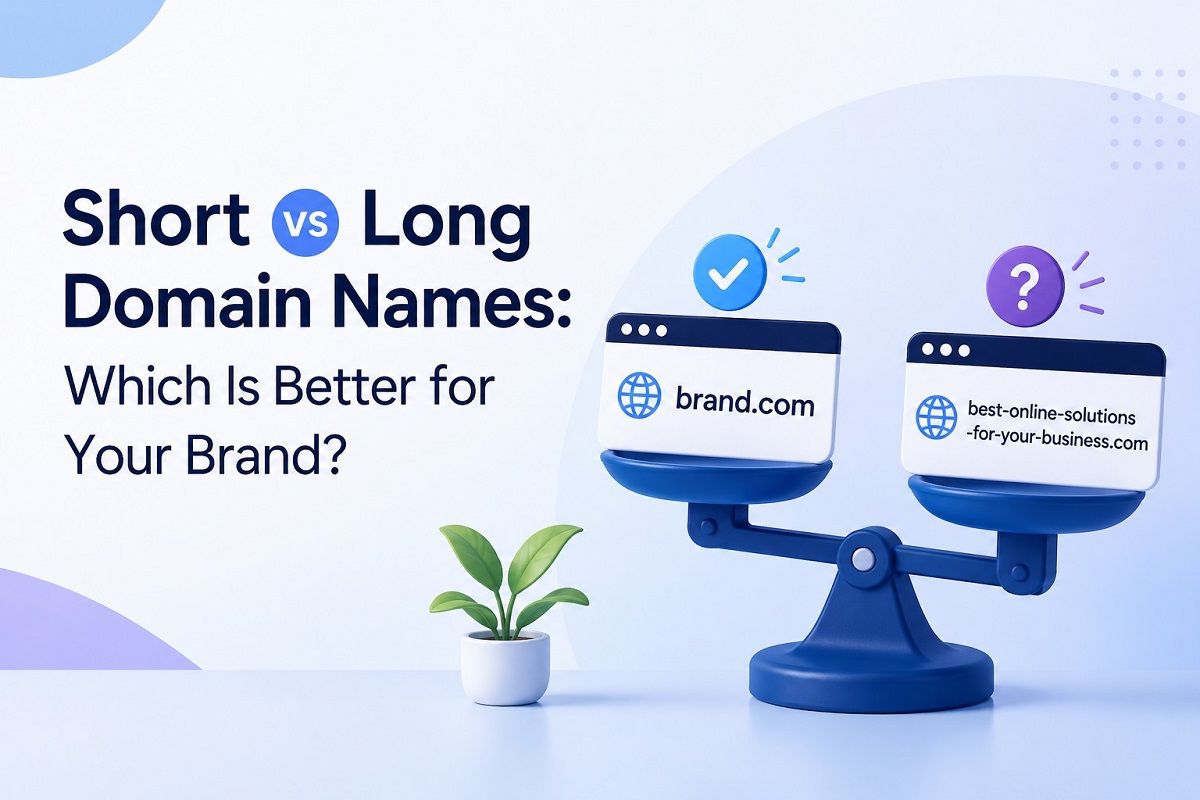
One of the most common questions businesses face during the domain registration process is whether to choose a short domain name or a longer, more descriptive domain name.
A short domain can be memorable and easy to type, while a longer domain name may clearly explain what a business does and include relevant keywords. Both options can work successfully, but the best choice depends on your brand, audience, industry, and long-term digital strategy.
In this article, we compare short vs long domain names and explain which option may be better for your brand.
Why Your Domain Name Matters for Your Brand?
A domain name is a key part of your online identity. It is often one of the first things potential customers see when they search for your business, visit your website, receive an email, or see your brand promoted online.
A strong business domain name can help improve brand recognition and create a more professional online presence. It can also make your website easier to remember and share.
The right domain name should ideally be easy to understand, easy to spell, relevant to your business, and suitable for long-term growth. While keywords can be useful in certain situations, a domain name should primarily support your overall brand identity rather than simply trying to include as many search terms as possible.
Whether you choose a short or long domain name, clarity and memorability should always be important considerations.
What Is a Short Domain Name?
A short domain name typically uses fewer characters and is designed to be simple, memorable, and easy to type.
For example, a domain such as:
- bright.com
is significantly shorter than:
- brightdigitalmarketingservices.com
Short domain names are often attractive because they are easy for users to remember. They can also look cleaner in advertising, social media profiles, email addresses, and printed marketing materials.
Many well-known brands use short domains because simplicity can make a website address easier to recognise and recall.
However, finding a short domain name can be challenging. Many short and popular domain names have already been registered, particularly with extensions such as .com. This means businesses may need to explore creative brand names, alternative domain extensions, or variations of their preferred name.
Benefits of Short Domain Names
One of the biggest advantages of a short domain name is memorability. A simple domain is generally easier for customers to remember after seeing it once.
Short domain names are also easier to type. This can reduce the risk of spelling mistakes when users enter your website address directly into a browser.
From a branding perspective, a short domain can create a clean and professional image. It can fit more easily on business cards, advertisements, product packaging, and social media profiles.
Short domains can also work well for business email addresses. For example:
is often easier to communicate than a long and complicated email address.
Another advantage is flexibility. A brand-focused short domain may allow your company to expand into new products or services without making the domain name feel too limited.
For example, a company using a broad brand domain can introduce new services without needing to change its website address.
Challenges of Short Domain Names
Although short domain names have many benefits, they can also be difficult to secure. Highly desirable short domains are often already registered or available only at premium prices.
Businesses may sometimes be tempted to choose unusual spellings or abbreviations simply to create a shorter domain. While this may make the domain shorter, it can also make it harder for customers to remember or spell correctly.
A very short domain name may also lack context. If the name is completely unrelated to the business, customers may not immediately understand what the company offers.
This does not necessarily make it a poor choice, but it means the business may need to invest more effort into brand awareness and marketing.
What Is a Long Domain Name?
A long domain name usually contains more words or characters and may describe the business, product, service, or location.
For example:
- bestdigitalmarketingagency.com
or
- affordablewebdesignservices.co.uk
are more descriptive than a short brand name.
Long domain names can clearly communicate what a business does. This can be useful for businesses that want their website name to provide immediate context.
They may also include relevant domain keywords related to products, services, or locations.
However, longer domains can become difficult to remember if they contain too many words or complicated phrases.
The goal should not be to make a domain as descriptive as possible. Instead, businesses should aim for a balance between clarity, simplicity, and brand identity.
Benefits of Long Domain Names
A descriptive domain name can immediately communicate the purpose of a website.
For example, a domain containing terms related to web hosting, website design, ecommerce, online marketing, or domain registration may help visitors understand what type of business they are visiting.
Longer domain names may also provide more availability. Because short domains are highly competitive, businesses often have more options when choosing a longer name.
A descriptive domain can also be useful for local businesses. Adding a relevant location may help make the brand more specific, such as a business targeting customers in a particular city or region.
For startups and new businesses that have not yet established strong brand recognition, a descriptive domain name can sometimes make the business easier to understand.
Challenges of Long Domain Names
The main disadvantage of a long domain name is that it can be difficult to remember.
If a domain contains several words, customers may forget the exact order or spelling. This can make direct website visits more difficult.
Long domain names can also increase the chance of typing errors.
For example, a customer may remember that a website included the words “digital”, “marketing”, and “agency” but forget the exact order of those words.
Very long domains can also look less professional and may be difficult to use in marketing materials.
For this reason, businesses should generally avoid unnecessarily long domain names, complicated phrases, repeated keywords, or excessive use of hyphens.
Short vs Long Domain Names: Which Is Easier to Remember?
When it comes to domain name memorability, shorter is often easier.
A short and distinctive domain can be easier to recall, particularly when customers hear it in a conversation, advertisement, podcast, video, or radio promotion.
However, length is not the only factor that affects memorability.
A longer domain can still be memorable if it uses simple, familiar words and has a logical structure.
For example, a domain such as:
- greenhome.com
may be easier to remember than a random six-letter abbreviation.
Similarly:
- londonbakery.com
could be easier to remember than a short but confusing domain with no clear meaning.
The best domain names are usually easy to pronounce, easy to spell, and easy to understand.
Short vs Long Domain Names for SEO
Many business owners wonder whether having keywords in a domain name will improve search engine rankings.
While a keyword-rich domain may provide context about a website, a domain name alone should not be considered a major SEO strategy.
Search engines evaluate many factors when determining rankings, including:
- Website content
- Content quality
- Search relevance
- Website structure
- User experience
- Page speed
- Mobile usability
- Backlinks
- Technical SEO
- Brand authority
A long domain name filled with keywords does not automatically rank better than a shorter branded domain.
For example, a domain such as:
- bestcheapwebhostingservicesonline.com
is unlikely to perform well simply because it contains multiple keywords.
In fact, overly keyword-focused domains can sometimes look less trustworthy or difficult to remember.
A strong SEO strategy should focus on creating high-quality content, improving website performance, targeting relevant search keywords, and building a recognisable brand.
If a relevant keyword fits naturally into your domain name, it can be useful. However, it should not make the domain unnecessarily long or complicated.
Short vs Long Domain Names: Which One Should You Choose?
For most businesses, a shorter domain name is usually easier to remember, easier to type, and stronger for long-term branding. However, this does not mean that the shortest possible domain is always the best choice. A short domain with no meaning may be less effective than a slightly longer domain that clearly represents your business. Similarly, a long domain packed with keywords may describe your services but become difficult for customers to remember. The best domain name usually sits somewhere between these two extremes. It should be short enough to remember but descriptive enough to make sense. It should support your brand without becoming overly complicated. A strong domain name should also be flexible enough to grow with your business.
Final Thoughts
The debate between short vs long domain names does not have a single answer for every business.
Short domain names are generally better for memorability, branding, typing, and professional email addresses. Long domain names can provide greater context and may offer more availability, especially when targeting a specific niche, service, or location.
The most important thing is not simply choosing the shortest or longest option. It is choosing a domain name that is clear, memorable, brandable, and relevant to your business.
When searching for the best domain name, focus on your long-term brand identity rather than chasing keywords alone.
A well-chosen domain can become one of your most valuable digital assets. It supports your website, business email, online marketing, SEO strategy, and overall brand presence.
Whether you choose a short branded domain or a longer descriptive name, make sure it is easy for your customers to find, remember, and trust.