

- By admin
- August 28, 2026
- Comment Off
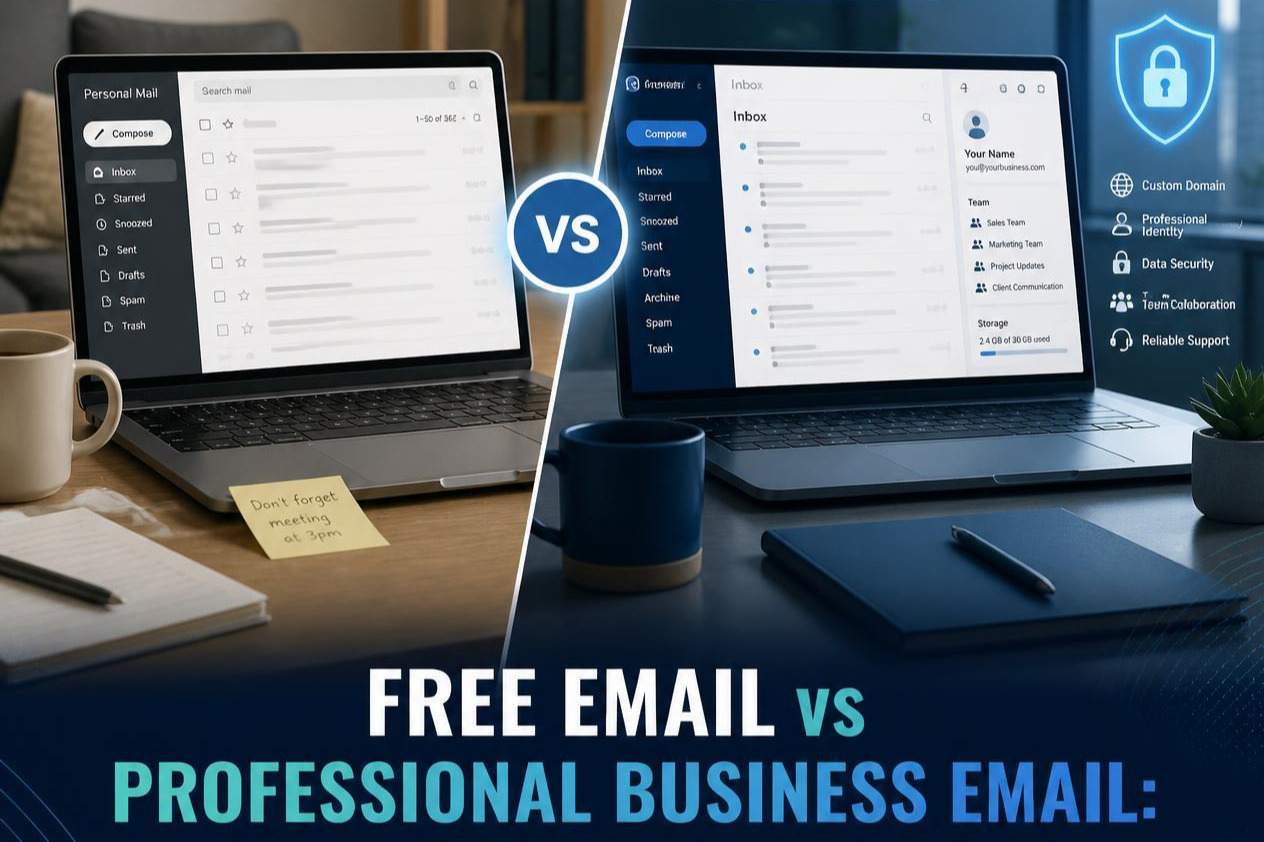
Email remains one of the most important communication tools for businesses. Whether you are a freelancer, startup, ecommerce company, agency, consultant, or established organization, email is often the first way customers, prospects, suppliers, and partners communicate with you. This is why the debate of Free Email vs Professional Business Email matters more than most business owners realize — the choice can directly impact how your brand is perceived.
But there is an important choice to make: Should you use a free email account such as Gmail or Outlook, or should you use a professional business email with your own domain?
A free email account can be convenient and suitable for personal communication. However, for businesses that want to build credibility, strengthen their brand, and maintain a professional image, a business email address can offer significant advantages.
Let’s compare free email and professional business email to help you decide which option is right for your business.
What is a Free Email Account?
A free email account is an email address provided by services such as Gmail, Outlook, Yahoo Mail, and other email platforms.
For example:
or
These accounts are generally quick to create and don’t require you to own a domain name. They can be useful for personal communication, testing ideas, signing up for online services or running a very small side project.
The biggest advantage is simplicity. You can create an account quickly and access it from almost any device.
However, when you’re communicating with customers professionally, the email address you use can influence how people perceive your business.
What Is a Professional Business Email?
A professional business email uses your company’s own domain name.
For example:
Instead of relying on a free email provider’s domain, your email address is connected to your business website and domain.
To create one, you generally need a domain name, a business email service and appropriate email hosting or a provider that includes email with your domain.
A professional email address helps create a consistent business identity and can make communication appear more established and trustworthy.
Free Email vs Professional Business Email
The biggest difference is branding.
Consider these two addresses:
and
Both can send and receive emails, but the second option clearly communicates that the email belongs to a business using its own domain.
A professional email address can therefore become an important part of your overall business branding strategy.
1. Professional Email Builds Trust
Trust is particularly important when you’re contacting customers, sending quotations, responding to enquiries or discussing payments.
An email from [email protected] looks more closely connected to the company than an address such as [email protected].
This doesn’t mean a free email address is automatically untrustworthy. However, a professional business email gives customers another signal that they are dealing with an established organization.
For businesses that regularly communicate with clients, suppliers and partners, this can make a meaningful difference to the overall customer experience.
2. Strengthen Your Business Branding
Your domain is an important part of your digital identity. Using that same domain for your email creates consistency across your website, email communication and marketing materials.
For example:
- Website: yourbusiness.com
- Email: [email protected]
- Sales: [email protected]
- Support: [email protected]
This creates a consistent business email address structure that customers can easily recognize.
Instead of promoting one brand through your website and another identity through your email provider, everything is connected to your company’s domain.
3. Create Professional Email Addresses for Different Departments
One major advantage of professional email hosting is the ability to create multiple addresses for different functions.
Depending on your business, you might use:
- [email protected]
- [email protected]
- [email protected]
- [email protected]
- [email protected]
- [email protected]
- [email protected]
This makes it easier to organize communication as your company grows.
You can also create individual employee accounts such as:
This provides a more structured approach to business email hosting.
4. Improve Your Business Credibility
Imagine receiving two proposals from two companies.
Company A sends an email from:
Company B sends an email from:
While an email address alone doesn’t determine whether a company is legitimate, the second address can create a stronger professional impression.
For consultants, agencies, service businesses, ecommerce stores and B2B companies, a professional email address can support a more credible brand image.
This is especially useful when sending:
- Business proposals
- Invoices
- Quotations
- Contracts
- Client updates
- Sales communications
- Customer support messages
5. Better Control as Your Business Grows
A free email account can work well when you’re working alone. But as your business expands, email requirements usually become more complicated.
You may need accounts for employees, departments and different business functions.
With business email hosting, you can generally manage email accounts under your company’s domain and create or remove addresses as your team changes.
For example, when a new employee joins, you can create:
When they leave, the account can be managed according to your company’s internal processes.
This is much more suitable for businesses that need centralized email management.
6. Support Your Business Email Security
Security should be an important consideration regardless of whether you use free or professional email.
However, businesses should pay particular attention to business email security because compromised email accounts can expose sensitive conversations, documents, customer information and financial details.
When selecting a professional email provider, look for features such as:
- Two-factor authentication
- Spam and malware filtering
- Secure login
- Account recovery options
- Encryption
- Administrative controls
- Email authentication support
- Reliable backups or recovery options
You should also use strong, unique passwords and avoid sharing account credentials.
7. Professional Email Can Improve Customer Communication
A professional email structure can make it easier for customers to understand where to send their enquiries.
For example:
- [email protected] — sales enquiries
- [email protected] — customer support
- [email protected] — billing questions
- [email protected] — job applications
This creates a clearer communication system and can help your team manage incoming messages more efficiently.
8. Your Domain and Email Work Together
If you already own a domain name, setting up a custom domain email is a logical next step.
For example, if your website is:
- yourbusiness.com
your business email could be:
This is often referred to as a domain-based email address.
The domain connects your website and email under one recognizable brand identity.
If you are still choosing a domain, consider selecting a name that is short, memorable and easy to spell. A strong domain can support both your website and your professional email strategy.
Is Free Email Bad for Business?
Not necessarily.
Free email can still be appropriate for certain situations.
For example, freelancers testing a new idea, very small businesses in their early stages, personal projects or temporary communications may find free email sufficient.
The problem isn’t that free email is inherently bad. The question is whether it meets your business needs.
If you’re regularly communicating with customers and want to establish a strong brand identity, a custom domain email is usually the more professional choice.
Is Professional Business Email Worth the Cost?
For most established businesses, the cost of professional email is relatively small compared with the potential branding and operational benefits.
You are not simply paying for an inbox. You’re investing in:
- Brand credibility
- Professional communication
- Custom email addresses
- Business identity
- Administrative control
- Security features
- Scalability
If your business already has a domain, setting up professional email can be one of the simplest ways to make your online presence look more established.
How to Choose a Business Email Provider?
When selecting a business email provider, don’t choose based only on price.
Consider the features your business actually needs.
Look for:
- Custom Domain Support: The provider should allow you to use an email address connected to your own domain.
- Reliable Email Delivery: Business emails should reliably reach customers without unnecessary delivery problems.
- Security Features: Look for two-factor authentication, spam protection, malware filtering and other security controls.
- Storage: Consider how much mailbox storage your team needs, particularly if employees frequently exchange large attachments.
- Multiple Accounts: If you have employees or departments, make sure the service allows you to create the number of accounts you need.
- Easy Management: An intuitive administration system can make it easier to create accounts, reset passwords and manage users.
- Customer Support: Reliable support can be valuable when dealing with email configuration, DNS records or delivery issues.
What Email Address Should a Small Business Use?
There is no single answer for every company, but a simple structure works well for many businesses.
A small company could start with:
or
As the business grows, additional addresses can be introduced:
This keeps communication organized without creating unnecessary complexity.
Free Email or Professional Business Email: Which Should You Choose?
Free Email vs Professional Business Email — Which Should You Choose?
If you are using email primarily for personal communication, a free email account may be perfectly adequate. If you are operating a business, however, a professional business email is generally the better long-term choice. A custom email address connected to your domain helps create a consistent brand identity, improves the professional appearance of your communications and provides a foundation for managing email as your business grows.
Final Verdict
When it comes to Free Email vs Professional Business Email, the choice ultimately comes down to your goals. Free email is convenient. Professional business email is built for business.
If you’re launching a new company and already have a domain name, consider setting up a custom domain email rather than relying on a generic free email address.
A professional email such as [email protected] is simple, memorable and directly connected to your brand.
Ultimately, the right choice depends on your budget, business size and communication requirements. But for businesses serious about building credibility and maintaining a professional online presence, investing in business email hosting is usually a worthwhile step.
Your website establishes your digital presence. Your professional email helps reinforce that identity every time you communicate with a customer.