

- By admin
- August 21, 2026
- Comment Off
Choosing the right domain name is one of the first and most important decisions when creating a website. Your domain is more than just a web address—it represents your brand, helps customers find your business online, and can influence how professional and memorable your website appears.
Whether you are starting a new business, launching an eCommerce store, creating a personal website, or building a blog, it is important to choose a domain name carefully. A good domain can support your branding and online visibility, while a poor choice can make your website harder to remember and promote.
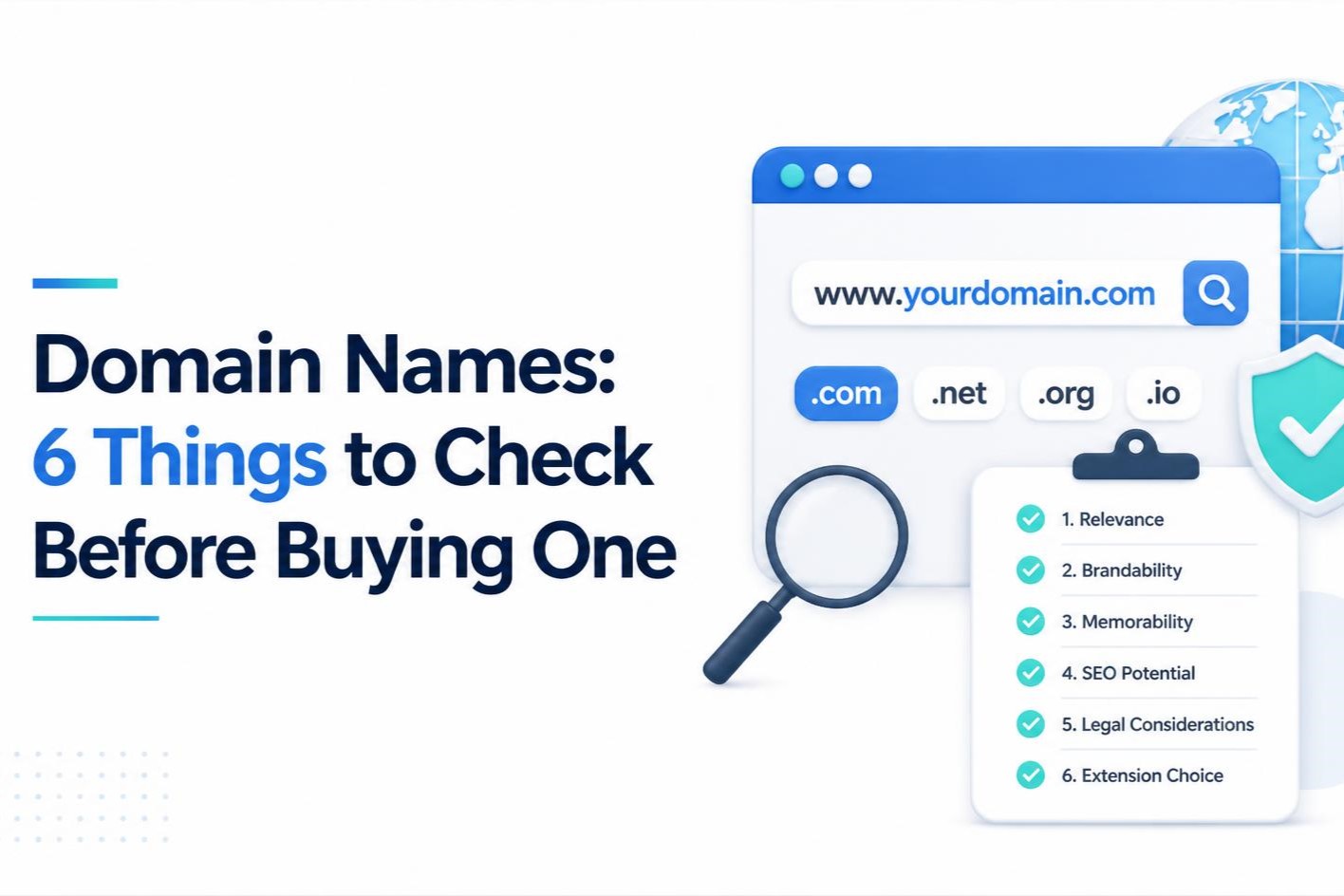
Before you buy a domain name, consider these six important factors.
1. Choose a Short and Memorable Domain Name
One of the most important things to consider when buying a domain is how easy it is to remember.
A good domain name should be:
- Short and simple
- Easy to spell
- Easy to pronounce
- Easy to remember
- Relevant to your brand or business
- Easy to type on mobile devices
Avoid unnecessarily long domain names, complicated spellings, or combinations of numbers and symbols.
For example, a domain such as brightwebsolutions.com may be easier to remember than a long domain containing multiple words, numbers, or unusual spellings.
Your goal should be to create a memorable domain name that customers can easily recall when they want to visit your website.
2. Check the Domain Extension
The domain extension, also known as a top-level domain (TLD), is the part that appears after the domain name.
Some popular examples include:
- .com
- .co.uk
- .org
- .net
- .io
- .store
- .online
For many businesses, a .com domain remains a popular and recognizable choice. However, the best domain extension depends on your target audience, industry, and location.
For a UK-focused business, a .co.uk domain name may be useful for establishing a connection with the UK market. Similarly, businesses targeting a particular country may consider a relevant country-code top-level domain (ccTLD).
When choosing a domain extension, think about where your customers are located and how you want your business to be perceived.
Domain Name vs Website Hosting: What’s the Difference?
3. Check Domain Availability and Trademark Issues
Before you purchase a domain, make sure the name is actually available and does not create potential trademark problems.
A domain may be available for registration while still being confusingly similar to an existing company’s trademark or brand name. Buying such a domain could potentially lead to legal disputes or require you to change your website address later.
Before registering a domain name:
- Search for existing businesses using the same or similar name.
- Check relevant trademark databases.
- Search Google for the proposed brand name.
- Check social media availability where appropriate.
- Make sure the name does not unintentionally copy an established brand.
This is an important part of domain name research that should not be overlooked.
If you plan to build a long-term business, choosing a unique and distinctive domain from the beginning can save time and money later.
4. Avoid Numbers, Hyphens and Confusing Spellings
While numbers and hyphens are allowed in many domain names, they can sometimes make a domain harder to communicate.
Imagine telling someone your website address over the phone:
my-business4u.com
The customer may wonder whether the domain uses the number “4” or the word “four,” and whether the domain contains a hyphen.
This can create unnecessary confusion.
For most businesses, a straightforward brandable domain name is easier to communicate and remember.
However, there are situations where numbers or hyphens may make sense. The key is to ensure the domain remains easy to understand and type.
5. Consider Your Brand and SEO Strategy
Your domain name should support your overall brand identity.
Many people assume that putting exact keywords into a domain automatically guarantees better Google rankings. This is not the case. Search engines consider many factors when ranking websites, including content quality, relevance, technical SEO, backlinks, user experience, and website authority.
However, a relevant and brandable domain can still contribute to a clear online identity.
For example, if you operate a web design company, a domain that clearly represents your brand and services may be more valuable in the long term than a domain stuffed with multiple keywords.
When choosing a domain, focus on:
- Brand recognition
- Relevance
- Memorability
- Long-term usability
- Customer expectations
- Overall SEO strategy
An SEO-friendly domain name should feel natural and support your wider digital marketing strategy rather than trying to manipulate search rankings.
6. Check the Registrar, Renewal Cost and Ownership Terms
The price you see when searching for a domain is not the only cost you should consider.
Before you register a domain name, check:
- First-year registration price
- Renewal price
- Transfer fees
- Domain privacy options
- Auto-renewal settings
- DNS management
- Customer support
- Domain ownership information
- Available management features
Some domain providers offer attractive introductory prices but charge significantly higher renewal fees.
It is therefore important to understand the domain renewal cost before purchasing.
You should also make sure that the domain is registered in your name or your business’s legal ownership details, where appropriate. Keeping accurate registration information can help prevent ownership and account-management problems in the future.
What Makes a Good Domain Name?
A strong domain name should ideally be:
Short + Relevant + Memorable + Brandable + Easy to Type
Before you purchase, say the domain out loud. Ask someone else to spell it after hearing it. If they struggle to understand the spelling, customers may have the same problem.
Also consider whether the name will still work if your business expands. A domain that is too specific to one product or location may become restrictive as your company grows.
Final Thoughts
Buying a domain name is a relatively simple process, but choosing the right one requires careful consideration. The best domain names are easy to remember, align with your brand, work well for your target audience, and make sense for your long-term business plans.
Before you buy a domain, check its availability, extension, trademark considerations, spelling, branding potential, and ongoing renewal costs. Taking a little extra time to research your options can help you avoid expensive changes later.
Your domain is the foundation of your website’s online address and can become an important part of your brand identity. Choose it carefully, register it with a reputable domain registrar, and make sure you maintain control of the domain as your business grows.