

- By admin
- August 21, 2026
- Comment Off
If you’re planning to build a website, one of the first comparisons you’ll come across is Domain Name vs Website Hosting. They are closely connected, but they serve completely different purposes.
A simple way to understand it is this:
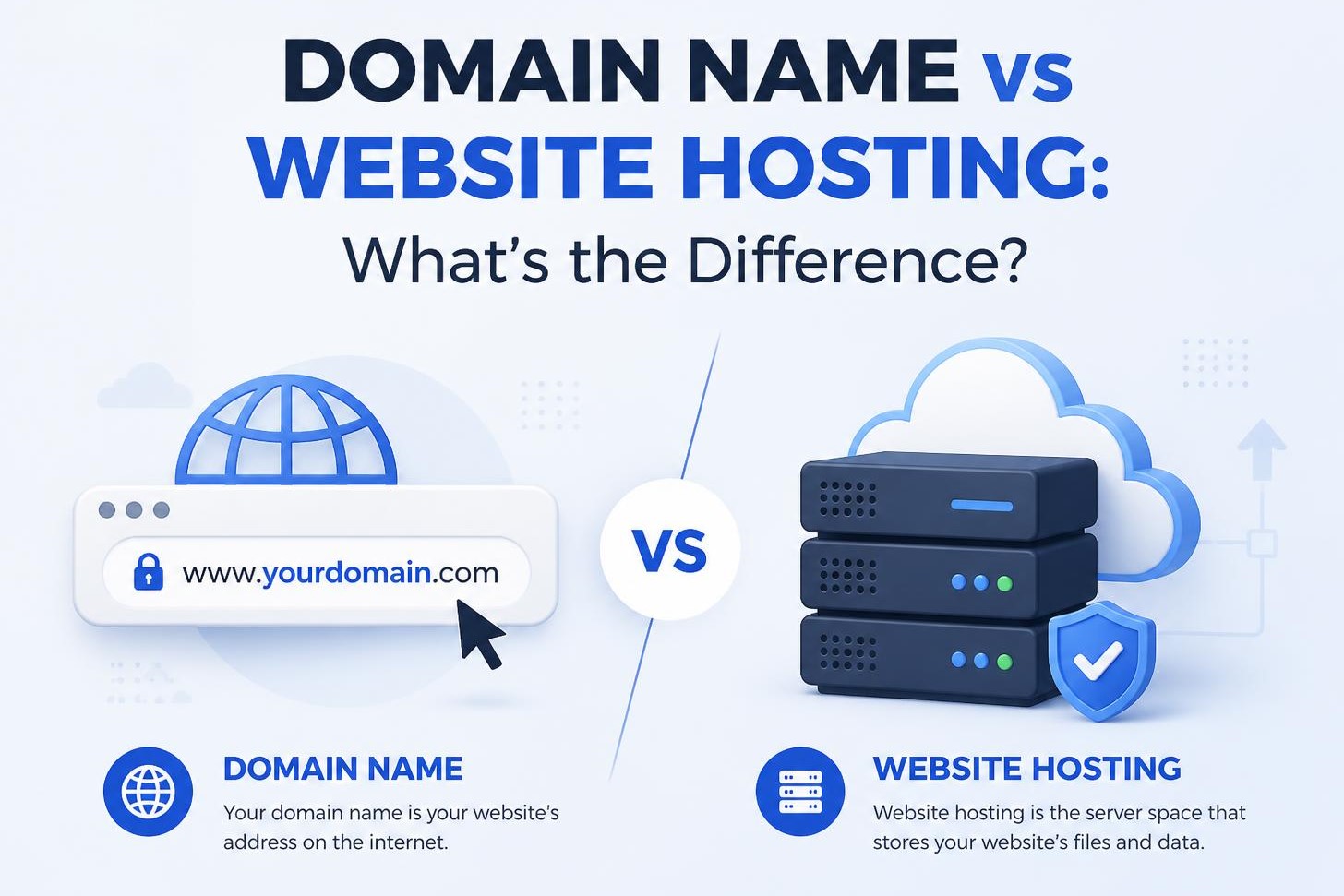
Your domain name is your website’s address, while web hosting is the space where your website lives.
You need both if you want people to visit your website using a memorable web address. Understanding the difference between a domain and hosting can help you choose the right services, avoid unnecessary costs, and get your website online without confusion.
Whether you’re launching a small business website, online store, personal blog, portfolio, or professional service website, let’s look at how domain names and web hosting work together.
What is a Domain Name?
A domain name is the unique web address people type into their browser to find your website.
For example: yourbusiness.com
Instead of asking visitors to remember a complicated IP address made up of numbers, a domain gives your website a simple, recognizable name.
Some examples of domain extensions include:
- .com
- .net
- .org
- .co
- .uk
- .ae
- .io
- .store
- .online
The domain name is an important part of your online identity. For a business, it can become closely associated with the company’s brand.
For example, if your business is called ABC Digital, you might choose a domain such as:
abcdigital.com
The domain itself doesn’t contain your website’s pages, images, products, or database. Instead, it acts as the address that helps visitors find those resources.
Domain Name: 6 Things to Check Before Buying One
What is Website Hosting?
Website hosting, also known as web hosting, is the service that provides server space and resources for storing your website.
Your website contains many different files and resources, including:
- HTML files
- CSS files
- JavaScript
- Images
- Videos
- Documents
- Databases
- WordPress files
- Plugins
- Themes
These files need to be stored on a server connected to the internet.
A web hosting provider provides that server environment and keeps your website available to visitors.
When someone enters your domain name into their browser, the domain directs them toward the appropriate hosting server. The server then delivers the website’s content to the visitor’s browser.
That’s why you generally need both a domain name and web hosting to run a traditional website.
Domain Name vs Website Hosting: The Simple Difference
Think about your business in the real world.
Your domain name is similar to your business address.
Your web hosting is similar to the physical building where your business operates.
The address helps people find you, while the building provides the actual space where your business exists.
Similarly:
- Domain name = Website address
- Web hosting = Website storage and server
They work together, but they are not the same service.
How Do Domain Names and Hosting Work Together?
When someone enters your domain name into a browser, several things happen behind the scenes.
For example, a visitor enters:
- www.yourbusiness.com
The domain’s DNS records help direct the request to the appropriate server.
The hosting server then processes the request and sends your website files back to the visitor’s browser.
The browser displays the website.
In simple terms:
- Visitor → Domain Name → DNS → Hosting Server → Website
This process happens extremely quickly, usually without the visitor needing to know anything about the technical side.
Shared vs VPS vs Cloud Hosting: Which Is Right for Your Website?
Do You Need a Domain Name and Web Hosting?
If you want to create a normal public website, you will generally need both.
You need a domain name so visitors have an address they can use to reach your website.
You need web hosting so the website’s files and data have somewhere to live.
Buying a domain name alone doesn’t automatically create a website.
Similarly, purchasing hosting doesn’t necessarily give you a unique branded domain name.
Some hosting providers may include a free domain for the first year with certain plans, but domain registration and hosting remain separate concepts.
Can You Buy a Domain and Hosting From Different Companies?
Yes.
You don’t have to purchase your domain name and hosting from the same provider.
For example, you might register your domain with one domain registrar and purchase web hosting from another company.
You can then connect the domain to your hosting account by configuring the appropriate DNS settings.
This gives you flexibility when choosing your services.
However, some beginners prefer purchasing both from the same provider because the setup and management process can be simpler.
The most important thing is to choose reliable providers and understand who controls your domain and hosting accounts.
What Happens If You Buy a Domain Without Hosting?
You can absolutely register a domain without purchasing web hosting.
In that situation, you own or control the domain registration, but there may not be a website connected to it.
You could use the domain for other purposes, such as:
- Professional email
- Domain parking
- Redirecting visitors
- Landing pages
- Connecting it to an external platform
- Using it later for a website
For example, you could register:
yourcompany.com
and use it for:
even if you haven’t launched your website yet.
What Happens If You Buy Hosting Without a Domain?
You can purchase a hosting plan without immediately registering a custom domain.
Your hosting account may provide a temporary address that you can use while building the website.
However, if you want customers to easily find your business online, you’ll normally want to connect a professional domain name.
For businesses, using a custom domain is generally much more professional than relying on a temporary hosting address.
Domain Name vs Website Hosting: Which One Is More Important?
It’s not really a question of one being more important than the other because they perform different functions.
A domain gives visitors an easy way to find your website.
Hosting provides the infrastructure required to store and serve your website.
For a business website, both are important.
However, your domain name can have a particularly long-term impact on your branding. You may keep the same domain for many years, even if you change your website design or move between hosting providers.
That’s why choosing a suitable domain name deserves careful consideration.
Final Thoughts
Understanding the difference between a domain name and website hosting is essential when creating a website.
Your domain name is the address people use to find your website, while web hosting provides the server space and resources needed to store and deliver your website.
Think of it this way:
- Domain = Address
- Hosting = Home
You need the address so people know where to find you, and you need the home to provide the actual space for your website.
When choosing your domain name, focus on something memorable, relevant, easy to spell, and suitable for your brand. When choosing web hosting, look at performance, reliability, security, backups, support, scalability, and overall value.
Once your domain and hosting are connected correctly, you have the basic infrastructure needed to establish your business online.
And as your website grows, you can upgrade your hosting, change providers, add professional email services, improve security, and expand your website without necessarily changing your domain.